EDWARD VILLELLA / FOUNDING ARTISTIC DIRECTOR

A look in the mirror

Did you know that dancers do their own makeup and hair (unless a role requires special makeup)? And it is a process! Soloist Callie Manning is known around here as an expert in stage makeup and shared her step-by-step routine with us. Because it takes so long (usually around 45 minutes or so), here is a quick view at what the women of Miami City Ballet go through in front of the mirror before each performance.

Don’t miss Callie and the rest of Miami City Ballet during Program IV at Adrienne Arsht Center, April 9-11, and at Kravis Center, April 16-18.

Inside the dressing room

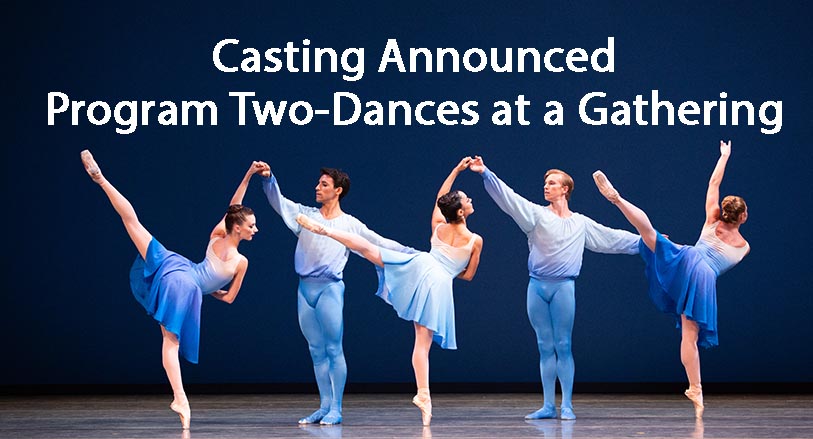
Program IV opened at Broward Center on March 12 with much success! Thanks to soloist Callie Manning, we got a sneak peek into one of the dressing rooms as the dancers got ready to perform Dances at a Gathering and Who Cares?. Check out this inside look at the makeup and accessories the ladies of MCB use for performances.

Don’t miss Program IV at Adrienne Arsht Center on April 9-11 and at Kravis Center on April 16-18. Click here for ticket information.

Katia Carranza – The Best of Both Worlds

Katia Carranza, former principal dancer, is back as a guest artist! She splits her time between Ballet de Monterrey (where her husband, former MCB Principal Luis Serrano, is Artistic Director) and Miami City Ballet. You might have seen her heating up the stage during The Neighborhood Ballroom; now, she’s going to perform Dances at a Gathering and Who Cares?. We sat down with her for a chat on what it’s like to dance in two companies and her history with MCB.

Memories and Finales

Post by Principal Dancer Deanna Seay

Like all years, as we get older, this one has flown by, and I can’t believe that we are already opening Program IV. More significantly, I cannot believe that this will be my 21st, and final, Program IV as a full-time member of Miami City Ballet. Each of the four programs that we present carries a particular feeling – the excitement of opening the season with Program I, for example. As Program IV closes the season, it is accompanied by the excitement of the summer, prospects of the coming season, as well as the bittersweet knowledge of knowing that roster changes mean that this will be the last time we all dance together. This last reason, of course, weighs heavily on me as I prepare this Program IV, so it is fitting that these final two ballets are so special to me.

The full Who Cares?, choreographed by George Balanchine to a series of songs by George Gershwin, was one of my early principal roles. Of the three principal women, I was given the jumping variation – a bit of a surprise since I never thought of myself as a “jumper.” Yet the variation was full of things that I could do — big moving sequences with lots of jazzy syncopation. Still, though, it is two minutes of jumping, but singing the lyrics in my head helped me find a dramatic impulse that allowed me to get past the burning muscles and lungs. Building a stairway to paradise is hardly easy work, but the hopeful, bounding combination of steps and music made the process a lot of fun.  My pas de deux, set to the title song, is at the other end of the spectrum — a bit more relaxed and without any sort of technical pyrotechnics. Hearing this music now brings back many years of memories; many different partners, theaters, rehearsals, circumstances, and that is actually what I feel the pas de deux reflects. While “Man I Love,” is the most romantic duet, and “Embraceable You,” highlights young love, “Who Cares?” seems to be a meeting of two old friends — possible former lovers, but maybe not. Regardless, they share a history, and have come together to remember the old times, maybe show off a little. It is a trip down memory lane for them, and in that, for me as well. Who Cares? is most definitely one of the oldest, most faithful of my “ballet friends” and one of the ones I shall miss the most.

The theme of nostalgic memories also carries through to Dances at a Gathering.  Set on the Company in 2005, it was one of my “later” roles, and in a completely different realm from Who Cares?. My particular character, the “Girl in Green,” arrives late, and performs a solo. More mime than dance, her gestures convey a series of movements already executed and delivered with an air of how wonderful everything was. During her second entrance, often referred to as the “Walk Waltz,” she dances, flirts, and flits around the stage, trying so very hard to attract the attention of the men that come and go. Her happy-go-lucky attitude surfaces when, after the last man has left, she shrugs as if to say, “Oh well…life goes on.”

This brings me to the finale. I have never experienced a finale like the one that closes Dances at a Gathering. Alarmingly simple, each dancer walks on stage and takes their place, looking around to observe the other dancers, the atmosphere, the stage. They gather, separate, and mingle, before finally dispersing as the curtain closes. Within all of this simplicity, though, is a moment with which I can’t help but to feel a profound connection. When the central male character kneels and places his hand on the floor, it is as if to indicate that it was here, in this place, that all the dancing happened. Watching him make this gesture, I feel that this moment could also express the gratitude I feel as I acknowledge that it has been here, in all of these theaters and with this Company that all of my dancing has happened.

Deanna Seay in Who Cares? Photo © Steven Caras.

Awaiting Open Barre

Leigh-Ann Esty got her hands on the Flip camera once again and headed straight into the studios for some thoughts on Open Barre. What are you looking forward to seeing during Open Barre 2?

Friday and Saturday nights are sold out, but you can still attend the Saturday afternoon performance at 2 p.m. Don’t miss it!

Sonatine, Coaching and Being Coached

Post by Principal Dancer Deanna Seay

I think that Sonatine is one of my favorite ballets to dance. Set to Maurice Ravel’s Sonatine for Piano, the dancing in this pas de deux is subtle and conversational. There is a perfume of intimate delicacy that pervades the atmosphere in Sonatine as the two dancers, dressed in elegant navy blue, enter the stage. Except that it is not a stage that they are entering; it is the arena for an experience to be shared between the dancers, a pianist, and whoever else may be in the vicinity. After initially listening to the sounds emanating from the piano, the dancers’ movements begin to describe the music. The genius of the beginning lies in the fact that the dancers direct their attention to the piano as the first theme is introduced. By the time that theme is heard again, the choreography has embraced the imagination in the score, with the steps performed by the dancers bringing new musical nuances to life. As the piece progresses through the contemplative middle section into the exciting final movement, it is possible to see that the dancers have illustrated the musical journey on which Ravel sent the listener. What began as a quiet, intimate composition, with the dancers constantly close to each other for support, moves on to introduce new moods and different energies before concluding at the opposite end of either a musical or dance spectrum: energetic, explosive, and expansive.

When we first prepared Sonatine, Violette Verdy and Jean-Pierre Bonnefous came to help stage and coach the work. They originated this pas de deux, which was created for New York City Ballet’s Ravel Festival in 1975. As I learned the steps, it became clear that with this ballet, Balanchine had created a portrait of these two dancers. The sequences created for Violette are intelligent, witty and sublimely musical; and by incorporating steps that are not entirely conventional, it is possible to see Violette’s sense of humor and imagination, too. It could have been easy for me to impose these ideas onto the choreography, though, as I had known Violette for a long time. However, I had never met Jean-Pierre before, but having studied a video of Sonatine for several days prior to their arrival, I was not surprised that he had a big, masculine presence and shared much of the same wit, refinement and intelligence as Violette.

Even though it has been ten years since I worked with Jean-Pierre and Violette on Sonatine, their memories still replay in my head. Violette’s comparisons between ballet and food are priceless, and while I can’t remember specifics, I am sure that she mentioned “whipped cream” more than once. I also fondly remember her attention to costume details; according to Violette, the best way to determine the length of a skirt is to have the ballerina stand on pointe in costume before trimming the edge. This way, it is possible to find the best overall proportion of lower leg, skirt length and bodice. Jean-Pierre worked primarily with the men, and he pushed them to find their own nuance throughout the work. He described one section of the male solo as “improvisation,” and allowed each man to create his own sequence of steps for this section.

Remembering my own coaching sessions in Sonatine also helps me find my way when trying to coach other dancers myself. For this Open Barre series, I was assigned to assist the dancers with Flower Festival Pas de Deux. There are many challenges that come with teaching a ballet to other dancers. For instance, once the steps are taught, how do I help them to look their best? How do I provide them with an accurate representation of the style? How do I push them to overcome whatever technical difficulties there might be? How do I convey the image I see in my mind, and how do I encourage them to push beyond the limits they may have set for themselves? I find myself often telling stories to the dancers I am working with, as I try to describe the origin of the idea I am trying to convey. These stories, in the case of Flower Festival, often come from my own experience dancing this ballet many years ago, as I try to remember the details I learned from Edward back then. So, it is a welcome relief when Edward comes into these rehearsals; I try to learn from him which details to look for, and how to communicate those details so clearly. Listening to him as he explains technical and artistic nuances, I am often amazed by his ability to identify problems and offer the simplest of solutions. Towards the end of Flower Festival, there is a sequence of hops during which the girl hangs on to the boy’s shoulder as he propels them both around to face the next direction. When the dancers seemed awkward attempting this sequence, Edward merely pointed out that they were initially too close together, and that the man needs to “duck” underneath the woman’s arm. “That was from Stanley,” he said, referring to Stanley Williams, the former School of American Ballet teacher who brought his Bournonville background to Balanchine’s company. With such depth of knowledge and experience as an example, I try to absorb as much as I can from him when he is in rehearsal so that I might be at least somewhat as helpful as he, but most often I just find myself happy that he is here to share these things himself.

Deanna Seay and Didier Bramaz in Sonatine. Choreography by George Balanchine. © The George Balanchine Trust. Photo by Joe Gato.

Frank Regan returns to the Ballroom

We were lucky enough to have Frank Regan, Period and Stylistic Choreographer of The Neighborhood Ballroom, join us once again to put the final touches on the ballet. Frank was here working with the dancers the week before Ballroom opened. Although he was very busy, we were able to steal a few minutes to chat with him!

Cindy takes you inside The Neighborhood Ballroom

Cindy Huang, MCB Corps de Ballet, recently took the Flip camera with her to document the behind-the-scenes of The Neighborhood Ballroom! Cindy captured rehearsal and backstage action in this special glimpse of the ballet during opening weekend at Adrienne Arsht Center.

Getting Ready for Ballroom – Part 4

Your last chance to see The Neighborhood Ballroom before the dancers get back into tutus and pointe shoes is this weekend at Kravis Center. You’ve already seen the costume bibles, the costumes for the first two acts of the ballet, and “THE FOX-TROT” costumes. Now, in the final installment of our series, Haydee shows us the hot costumes for “THE MAMBO” and gives us some background on how she found them!

From the Studio to The Neighborhood Ballroom

Post by Principal Dancer Deanna Seay

Ah…full-length story ballets. Often beautiful, always entertaining, audiences love to watch a story unfold onstage during an evening. Someone is always dancing, whether the corps de ballet or the principals, and the corresponding narrative seems to help the audience understand the dancing language. One of the six full-length works in our repertoire, The Neighborhood Ballroom is unique in its focus on several different time periods (the Belle Epoque, Jazz Age, 1940s war years, and the 1950s) and the related dance rage of each era). Edward Villella’s tribute to these different eras is a product of his extensive dance knowledge, and it is his vision that is fully realized with this production. His sense of detail brings to life four different acts dance trends, spanning from 1912 to the 50s.

Any full-length narrative work requires a lot of preparation, and The Neighborhood Ballroom is no exception. There are many details that must be polished to allow the story to emerge. Working these things out takes time; long rehearsals with intense focus are required to absorb these details, and while the process is ultimately rewarding, it is also exhausting. Each era must be recreated so as to be able to distinguish one from the other; the restrained behavior during the days of Absinthe and the Boston Waltz differs from the crazy experimentation that occurred during the Jazz era and the Quick-Step. One of the wonderful things about The Neighborhood Ballroom (or just “Ballroom,” as we call it) is that these nuances are achieved through the choreography, with the mood of each period expertly conveyed through its corresponding style.

It would not be possible to perform this work if the dancers in it did not love to dance so much. To begin with, there is so much dancing involved that several dancers are required to appear in all four acts. After many hours of rehearsals learning very detailed, style-specific choreography, watching the company members transform themselves from one period to another is very similar to watching a chameleon change colors – they fit themselves into the style instantly and effortlessly. The principals in each act work out the details of their individual characters, adding further dimension to the wonderfully-inventive pas de deuxs that occur throughout the evening. The technical side of this production is also very complicated; the level of excitement in watching the production crew accomplish the many special effects backstage nearly rivals the excitement of watching the dancers onstage. It never ceases to amaze me how much goes into the ambiance onstage; those beautiful serene moments that people see are the product of much more than meets the eye.

Deanna Seay in The Neighborhood Ballroom. Photo © Joe Gato.